Category: Lessons Learned

Mistakes, fixes, and what I’d tell another beginner.

  • Day Two: Locked Out by My Own Firewall (and Two Other Fixes)

    Day Two: Locked Out by My Own Firewall (and Two Other Fixes)

    Day one was about building the lab. Day two was about keeping it running. Three things went wrong, and each one taught me something different about operating infrastructure, not just building it.

    ProblemReal causeFix
    WordPress couldn’t resize imagesA PHP library was missingAdded it to my Ansible role
    Ansible timed out on both serversMy IP changed, twiceUpdated one Terraform variable
    “Error establishing a database connection”Database server wasn’t respondingRestarted it and checked with Run Command

    1. “The web server cannot generate responsive image sizes”

    When I uploaded screenshots for my posts, WordPress showed this warning. The message suggested converting my images to PNG, but they already were PNGs. The real problem was that my server was missing GD, the PHP library WordPress uses to make smaller copies of images for phones and thumbnails.

    The fix had to be in code, not on the server. If I’d installed it by hand, the next rebuild would lose it. So I added it to my Ansible web role, along with a few other PHP extensions WordPress recommends:

    - name: Install Apache and PHP
      ansible.builtin.apt:
        name:
          - apache2
          - php
          - php-mysql
          - php-gd
          - php-xml
          - php-mbstring
          - php-curl
          - php-zip
          - php-intl
          - libapache2-mod-php
        state: present
      notify: Reload Apache

    The notify line was new too. It tells Ansible to reload Apache, but only when this task actually changes something. When I ran the playbook, the recap showed the new packages installing, followed by RUNNING HANDLER [web : Reload Apache]. Then I saved the change through a pull request, so GitHub’s checks ran on it before it reached my main branch.

    2. Locked out by my own firewall

    Next, Ansible couldn’t connect to either server:

    ssh: connect to host <server IP> port 22: Connection timed out

    Nothing was broken. My firewall only allows SSH from one IP address, mine. I had worked from a different network earlier in the day, so my IP had changed. Then I went home, and it changed back. Both times, the firewall was doing exactly what I told it to: block everyone else.

    I compared my current IP with the one in my Terraform settings, updated that one variable, and applied it:

    Plan: 0 to add, 1 to change, 0 to destroy.

    Terraform updated only the firewall rule, without touching the servers. It finished in about two seconds.

    Lesson: when I switch networks, my IP changes, so I need to update that one rule. The blog stays reachable either way, because the firewall only limits SSH, not website visitors.

    3. “Error establishing a database connection”

    Then my blog showed WordPress’s database error. Azure said both VMs were running, but I couldn’t SSH into the database server.

    I restarted it, then used Run Command, an Azure feature that runs a command inside the VM through Azure’s own agent, without needing SSH:

    az vm run-command invoke -g rg-homelab -n vm-homelab-db \
      --command-id RunShellScript \
      --scripts "uptime; systemctl is-active mysql ssh"

    It reported the server had been up for 6 minutes, with both MySQL and SSH active. After that, my blog loaded normally.

    To be honest, I’m not completely sure what the original problem was. My firewall IP was also wrong at the time, which made both problems look the same from my laptop. When I logged in afterward, memory usage was at 69% on a small VM running MySQL, so the server may have run low on memory. Adding swap space, or giving the database server a slightly bigger VM, is on my list.

    What I learned

    • Fix it in code. A fix that only lives on the server disappears on the next rebuild.
    • Check one thing at a time. Two problems at once (a wrong IP and a struggling server) can look like one.
    • Compare to something that works. When one server answered and the other didn’t, I knew it wasn’t my whole connection.
    • Have a way in that doesn’t depend on SSH. Run Command let me check the server from inside Azure.
  • Setting Up a Cloud Lab on Windows with WSL

    Setting Up a Cloud Lab on Windows with WSL

    I use a Windows laptop, and Ansible only runs on Linux. The solution is WSL (Windows Subsystem for Linux), which runs Ubuntu right inside Windows. Here’s how I set up everything for my cloud lab, including the beginner mistakes I made along the way.

    1. Install Ubuntu with WSL

    In PowerShell (run as administrator):

    wsl --install

    After a restart, Ubuntu asked me to create a username and password.

    Beginner lesson: Linux shows nothing when you type a password. No dots, no stars. I thought my keyboard wasn’t working. It was.

    2. Get files from Windows into Linux

    Windows drives show up inside Ubuntu under /mnt/c. My first copy command failed because I typed the placeholder YOURNAME literally instead of my actual Windows username. This command found the file for me:

    find /mnt/c/Users -maxdepth 3 -name homelab.zip 2>/dev/null

    Beginner lesson: anything in ALL CAPS in a tutorial command is usually a placeholder you need to replace.

    3. Install the tools

    I installed four tools: Ansible, Git, Terraform, and the Azure CLI. Then I checked each one:

    ansible --version
    git --version
    terraform -version
    az version

    My Ubuntu version was so new that some installers didn’t support it yet, so I pointed Terraform’s installer at the previous Ubuntu release, which worked fine.

    4. Sign in to Azure and GitHub

    WSL can’t open a Windows browser on its own, so for both the Azure CLI and the GitHub CLI, I copied the sign-in link or code into my browser manually.

    az login
    gh auth login

    What I’d tell another beginner

    • Read every error message. Most of them say exactly what’s wrong.
    • Replace placeholders before running commands.
    • Check each step worked before moving to the next one.
    • Closing Ubuntu keeps your files, but you’ll need to re-run any export commands next time.
  • 5 Azure Errors I Hit on Day One (and How I Fixed Them)

    5 Azure Errors I Hit on Day One (and How I Fixed Them)

    My first night building this lab, I didn’t get a single clean run. I hit five errors in a row. Each one taught me something about how Azure actually works, so here they are.

    #ErrorWhat it meantFix
    1“You don’t have access to this”My school blocks device-code sign-inUsed regular browser sign-in
    2SubscriptionNotFoundNew subscription, services not registeredRegistered resource providers
    3RequestDisallowedByAzureStudent subscription only allows some regionsMoved to North Central US
    4InvalidResourceGroupLocationLeftover resource group in the old regionDeleted it and re-ran
    5SkuNotAvailableNo capacity for that VM sizeChanged one variable

    1. My school blocked one sign-in method

    I tried signing in to the Azure CLI with az login --use-device-code. The sign-in succeeded, but then I got “You don’t have access to this.” My school’s IT blocks that sign-in method for student accounts, which is a common security policy.

    Fix: I used the regular browser sign-in instead. Because I’m on Linux inside Windows (WSL), it couldn’t open a browser on its own, so I copied the sign-in link into my browser manually. That worked.

    az login

    2. SubscriptionNotFound

    My first attempt to create a storage account failed with SubscriptionNotFound, even though my subscription clearly existed. It turns out brand-new Azure subscriptions need each service “registered” before you can use it.

    az provider register --namespace Microsoft.Storage
    az provider register --namespace Microsoft.Network
    az provider register --namespace Microsoft.Compute

    I checked the status every 30 seconds or so until all three said Registered.

    3. RequestDisallowedByAzure

    Next, Azure refused to create anything in eastus. My Azure for Students subscription has a policy that only allows certain regions. I looked it up:

    az policy assignment list --query "[].parameters" -o json

    The allowed list was North Central US, Canada Central, Sweden Central, Norway East, and France Central. I picked North Central US because it’s closest to Georgia.

    4. InvalidResourceGroupLocation

    When I re-ran my setup in the new region, it failed again: the resource group already existed in eastus from my first attempt, and a resource group can’t move regions. I deleted it and started clean.

    az group delete --name rg-homelab-tfstate --yes

    5. SkuNotAvailable

    Finally, terraform apply built 10 of my 12 resources, then both VMs failed: Azure had no capacity for the Standard_B1s size in my region.

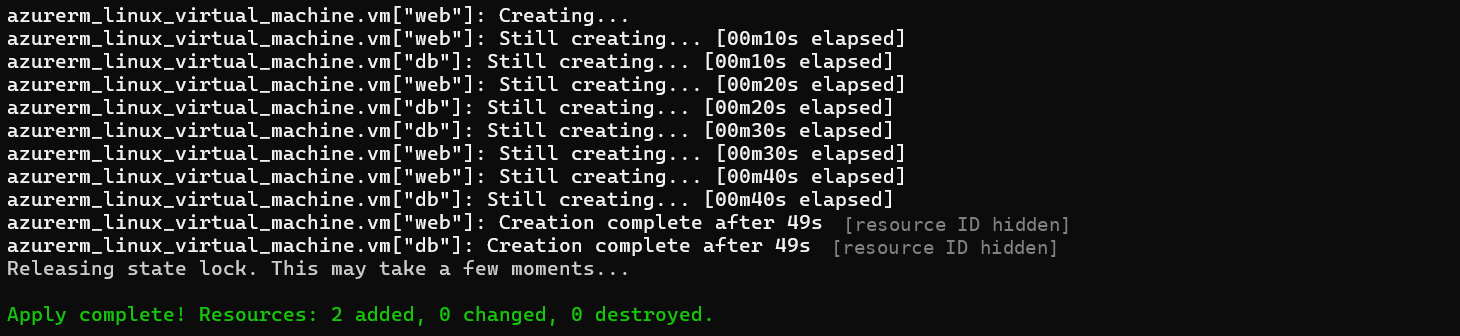
    Fix: I changed one variable to a different small size, Standard_B2ats_v2, and ran terraform plan again. It said “Plan: 2 to add.” Terraform’s state file remembered the 10 resources it had already built, so it only created the two missing VMs. They finished in 49 seconds.

    What I learned

    Every one of these error messages told me exactly what was wrong. The skill isn’t avoiding errors. It’s reading them carefully and fixing one thing at a time.